sábado, 31 de marzo de 2018

The Nile Civilization and the Great Pharaoh (part 2).


A day of September 1976, in the middle of an unusual movement, a militar plane landed in France. On board, and receiving State Honors was no less than a mummy. That flight had given a tour over some historic monuments before leaving Egypt, as a tribute to a very distinguished personality. The purpose on that trip was to treat the mummified body, to save it from a slow but continuous damage, due to microorganisms. 


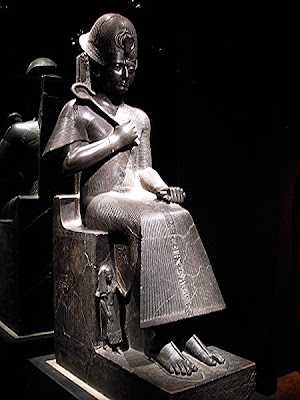
Those were the mummified remains of a remarkable person indeed: the pharaoh Ramesses II. It is sure that he would have felt quite satisfied, knowing that he would still receive high honors three thousand years after his death. But, how was the life of such a noteworthy character?


By the year 1340 BC. Egypt was immersed in chaos. The religious reforms of the pharaoh Akhenaten had started the rebellion of the priests, and soon there were riots all over the country. His fanaticism made him abandon his responsabilities as king and as military commander too. After some time, the crown ended into Horemheb's hands... he was a general without any relation with the royal family. As the new ruler, he tried to restore the internal order, and so at the frontiers. But he left unsolved the Hittites problem, a very important issue to Egypt.

When Horemheb died, the throne throne went to his vizier, another general: Ramesses I. He was an old man, but had male descendants, something very important then. Although he came from a high prestige military family, not a single drop of royal blood was running through his veins. As expected, this king had a short reign, a little more than a year. In 1303 BC. Egypt had a new pharaoh, Sethi I. 


By that time, the future Ramesses II was a ten years old boy. He was born in Avaris, on the eastern side of the Nile delta. Later he would move the capital of the country to this city, naming it as Pi-Ramesses. The prince grew up between his brothers and although he was not the first born, at the end was the heir to the throne. The boy received a high quality education, but to avoid succession intrigues, he was named as Regent Prince, still as a child.


Being only fifteen years old, Ramesses began to have military responsabilities. He served beside his father in campaings at Lybia and Syria. The first time he commanded troops was at Kush (Nubia) when he was twenty one. Also was in charge as mines and construction supervisor everywhere around the country. It seems that his liking for monumental building began on those days.


He got married still very young, at seventeen years old, with Nefertari... whom he seemed to love deeply. Despite that, nothing stopped him from having a numerous harem. Among them, he even came to have sisters and daughters! Outrageous as it may be, we should not forget that it was their way to keep the purity of the royal blood.

Ramesses II would have a quite large number of descendants, a hundred and fifty sons. It should has not been difficult to find a heir to the throne. But he reigned for so long, that he outlasted many of those sons. We might guess that more than one of them was aspiring to the crown, but had to remain waiting for his moment. Anyway, most of them got important positions, with high responsabilities as rulers. Finally, the heir was Ramesses' thirteenth son: called Merenptah.


As the new pharaoh, he wore the Two Reigns Crown in 1290 BC. after the funerals of his father, Sethi I. Soon he found himself in front of some military threats... was necessary to deal with the so called Sea Peoples. It was the name the Egyptians gave to any invader coming from the Mediterranean Sea. In that case, were Sards invaders. Ramesses II showed a high capacity, winning a naval battle (Egypt was not strong at the sea), and was clever enough to draw many of the enemies to his army.


Facing the progress of the rebellion on the Retjenu lands (Canaan and Lebanon), he decided to subdue them. The king acomplished it, but still had a huge obstacle in Syria, with their old enemies, the Hittites. They had become strong, and the clash was unavoidable. In many ways it was a remarkable battle: it was the first well documented confrontation of that magnitude in History... also was the last battle clearly associated to the Bronze Era technology.


They finally met at Kadesh or Qadesh. Another interesting issue results obvious: both sides claimed the victory. Everything seems to suggest that the four corps of the Egyptian army, which never gathered, were caught by surprise. The Hittites attacked earlier than expected, surrounding Ramesses II. He was in danger! A second corp was coming to support him, but the enemy destroyed it. So the pharaoh had to fight for his life, side by side with his men, showing a great courage and determination. At this point, some mistakes of the Hittites, permitted the Egyptians and allies to regroup.


How impressive the scene! Under a burning sun, the plain at the foot of the city, near to the Orontes river. The Hittite army with their massive war chariots, against the light and nimble Egyptian carts, opening gaps for the infantry corps. Flying darts: a true shower of arrows, into a huge cloud of dust. It was a tragic dance of shapeless bodies... to the rythm of a dreadful symphony of hittings and terrible screams. Were tens of thousands men fiercely struggling. Everything indicates that it lasted more than one day and finally the Egyptians took control of the situation. 


Ramesses II made of this battle a continuous self-praise theme. On several monuments he made to engrave the story of how by his own hand, he almost crushed and beat the Hittites. Of course, the latter had a different version, so leading to a controversy about who really won at Kadesh. We always prefer in such cases of doubt, to take an average option... like there were no winners or losers. If any of them won, was paying a high price. The truth was that the king of Hatti and the pharaoh, at the end had a peace agreement. There they talked as equals, and by the way: it is the first well documented accord between nations in History! Even more, Ramesses II married an Hittite princess, few years later, showing that they became allies. But the vanity excess of the pharaoh, could be excusable for a man who fought like a lion. His efforts leading his men, contributed to change the course of an almost lost battle. Sadly, with the pass of time, both civilizations resulted weakened due to their long wars. 


The rest of his prolonged reign, Ramesses II enjoyed of many peaceful periods. It allowed him to focus on his favorite activity: the monumental construction. Also, he was able to control the ethernal intrigues of the clergy, when he named a faithful person called Nebumenef, as the High Priest.


It seems possible that the captivity of the people of Israel had happened under Ramesses II goverment. The intense constructive activity of those times needed of all the workforce "available". Although no Egyptian inscription registers this, it is mentioned on the Bible (Exodus, 1:11). Maybe someday we get to know the truth of all theses happenings.


The most likely is that Ramesses II in his egomania, did not hesitate to take for him some monuments made by former pharaohs. He even erased earlier inscriptions, to write his own... but sure he was not the first to do it. Anyway, during his more than sixty years reign, he had time enough to build as he liked in all Egypt. Some scholars have thought that with his long lasting goverment and the high public expenses, began the empire decadence.


The magnificence of his architecture and sculptures have amazed many people. Those splendid ruins of Thebes, which make our imagination travel to the past. Karnak and its religious complexes, object of sumptuous works. The Abu Simbel temples, saved from its sinking under the waters of a dam, fifty years ago. The Ramesseum, destined to be his tomb, with his colossal statues, its abundant inscriptions and low reliefs. Those and many others, constitute a "gigantic architecture" not always praised by the experts.


In the year 1223 BC. this personage died, at ninety years. Ramesses II was a man with a strong personality, who knew well how to be tough and cruel. He kept himself distant from his people, but could maintain the common good and peace... even by the via of treaties and agreements; it all shows his political skills! 

He always has been depicted as a plentiful man: The Sun King, Ramesses the Great.


It is striking that precisely himself, has been who travelled from a remote past to bring us a message. With his mummified body, he is talking about the brevity and fragility of life... and how absurd are human arrogance and vanity. But, why could someone like him be destined to bring us such a message?

Sure we will come back to the Ancient Egypt, maybe we get to find answers, or perhaps more questions...

jueves, 22 de marzo de 2018

The Nile Civilization and the Great Pharaoh (part 1).


Through times, there have existed some cultures which dissapeared leaving behind only their works. But also, they have set out an enigma about who they were, how they lived and why they vanished. It could have happened the same with the Ancient Egypt civilization, despite of their archaelogical remains... those material signals and wonders, which have been the object of an ethernal looting.


Chefren's Pyramid and Sphinx at Giza, Egypt. Photo: Hajor, 2002. en.wikipedia
Lic. CC-BY-SA 3.0

As a matter of fact, life in Egypt was an unresolved issue along many centuries. If we take a closer look, its history has been like a huge puzzle, very slowly assembled and still with many missing pieces.


Herodotus. Ancient Agora Museum, Athens
Lic. CC BY-SA 3.0

By the Fifth Century before Christ (BC.), Herodotus, a greek historician began to search on the Egiptian past... but he only produced a group of scattered tales. Near 280 BC. a priest called Maneton, wrote in Greek (fortunately), a History and Cronology about the ancient kings of Egypt, from their origins till the times of Alexander the Great. His writings and historical sources have dissapeared, but several scholars from the antiquity could read them. They used Maneton's work, somehow saving it for the posterity.


Alexander the Great. Roman mosaic, ca 100aC. (detail). Source: The Guardian.
{{PD-US}}

Is important to keep in mind, that by the times of Alexander (332 AC.) Egypt already had a long history of millenniums. Hence, those writings surely had many and inmense "blackouts and gaps". 


Tutmose II (Aakheperenre) hieroglyphic. Photo:
Przemyslaw Idzkiewicz. Lic: CC-BY- SA 2.5
So many visible inscriptions on the monuments, tombs and papyrus, were a mystery. All those messages, among such a greatness, and nobody could understand them! The ancient Egyptians' script could not be interpreted for a good reason, was very complicated. Some experts, even came to think that were "riddles", and drawed conclusions without a real support.


The Rossetta Stone. British Museum,London. Dig, photo:
 Nicolás Pérez Gómez. Loaded by: Lourdes Cardenal
Source: Universal Free Enciclopedia  Lic. CC-BY-SA 3.0

This situation remained till the late 18th Century, when Napoleon's forces invaded Egypt. Among his people there were wise men and experts, who "collected" and classified every archaeological item. That way, they showed their interest and respect for the ancient culture. But one day, at the city of Rashid (Rosetta) they found a stele made of polished basalt, filled with inscriptions. It was written in three different languages: Hieroglyphic, Demotic and Greek, along three separated sections. From the begining they guessed that was the same message, written in those languages. Maybe in their hands was the key to understand the egiptian language... but how to use it? 


Jean-Francois Champollion. By: Léon Cogniet, 1831.
Louvre Museum. References: Joconde database 000PE000522
{{PD-US}}

After several attempts and failures of highly qualified linguists, there was some progress. By the year 1822, Jean-Francois Champollion with his hard work and high ingenuity, could decode the hieroglyphic writings. This finally opened the doors to a great, captivating and yet so unknown past. The life and works of this man are very interesting. Would be worthwhile to make a virtual visit to this remarkable human being.


Champollion's notebook. 19th century. Source: Les Cahiers de Science et Vie:
Les origines de l'escriture. {{PD-US}}

With this tool at hand, was possible to study, date and had a better look to the past of that country. A culture whose origins go back to the year 5000 BC. approximately. We are talking of seven thousand years ago.


The Nile river. Photo: Xosé Calvo, 2005.

The amazing and astonishing Egypt Civilization, always was bound to the river Nile existence. To conquer and domesticate the immense river for their use, impulsed the progress of the early inhabitants of those lands. Its annual floods left a fertile strip of land in the middle of the desert, which meant life to that country. 

Also, we should take into account the relative isolation of Egypt. Surrounded by huge deserts and by the sea, it was like a true "historic-cultural ecosystem". That made this civilization grow in the middle of special conditions, so becoming obstinately traditionalists. This was very marked on their religion and beliefs.


Egypt. From: www.todoegipto.org

Egyptian History began with their first written registers, around the year 3100 BC. This coincided with the time when the two main regions of the country were joined under one king. The lands of the Nile delta, received the name of Lower Egypt, while the rest of the territory was the Upper Egypt. 


Narmer Palette, facsimile. Royal Ontario Museum, Toronto
{{PD-US}} 


By then, at the dawn of history, Menes (Narmer) conquered and merged both reigns. He was from the Upper Egypt, and all the registers and cronologies from the egyptian kings, begin with him. Those who followed king Menes, through many centuries, were part of families or Dynasties. These, were grouped in Periods (as Maneton did). Along milleniums, the country underwent through magnificent Periods, but there were decadent and inestable times too. Also, is very likely that exist several errors and imprecisions in all this. 


Saqqara pyramid. Assumed author: Marperi, 2005. CC BY 2.5

As we said, the country had greatness or declining times. They conquered and expanded, but also they had foreign invaders taking on Egypt. Incompetent or wise monarchs... The capital city was continuosly moved, at the king's ease or convenience. All this ups and downs are logical, during such a long history.


Golden death mask of Tutankhamum. Egyptian Museum
Cairo, Egypt. Photo: MykReeve, 2002. en.wikipedia
Lic. CC BY-SA 3.0
The leading figure on Egypt History was the king, or pharaoh, always infused with a divine-like nature... although most of the time his human origin was evident. Such a greatness, joined to their religious beliefs, turned their funeral rites more and more sophisticated. It induced the magnificence of their culture, giving some of the most spectacular works ever made by man.

Among all pharaohs, maybe one is the most famous, for his battles and constructions, but also for his personality cult and egocentrism. He was Ramesses II, who ruled over Egypt for many years, since 1290 BC. His father was Seti I... but we better travel again to that epoch and places, mysterious and fascinating. To visit a country which has captivated man's imagination for such a long time.


miércoles, 7 de febrero de 2018

Roman Britain and the Rebellion of Boudica (part 3).


Rome, the Eternal City

The roman eagles would stay in Britain for almost three hundred and fifty years, after the rebellion of Boudica. Were peaceful or turbulent times, with many ups and downs, depending on the situation of Rome. The excessive growth of the empire, had increased the problem of keeping the borders. Besides, the political intrigues at the metropoli showed their influence over the provinces... as some generals became very prominent (and powerful), became the object of imperial suspicions. The reality often demonstrated that this mistrust was not wrong.


Nero

The insurrection of Boudica had such a severe punishment, that emperor Nero decided to replace the governor of Britain, to prevent the worst. But soon Rome would sink into anarchy, losing control over its farther provinces. It brought good times for the celtic resistance. But, by the year 77 AD, Vespasian finally could send his legions to Britannia again, under the command of general Gnaeus Julius Agricola. The latter, was father-in-law of the historian Tacitus, and had been present in times of the warrior queen.


Romans versus Celts

This general imposed the roman peace again. In successive campaigns, he controlled the western lands (Wales). They also advanced far to the north, reaching central Caledonia (Scotia) in the year 84, defeating the celtic tribes at Grampio. Agricola became very successful as a soldier, and also as a civilizing agent... spreading the roman culture in Britain.


Gnaeus Julius Agricola

The next emperor, Domitian, decided that it was no longer worthwhile to continue with the conquest of the northern lands of Britain. Soon he called Agricola back to Rome, to carry out another assingments. It also seems very likely, that he wanted to have a closer look on the conspicuous  general.

The Caledonians and Picts tribes searched for shelter in the northern mountains. They continued harassing the romans for years, consuming time and resources needed in other regions. At the same time, it was producing a progressive fatigue on the troops. In times of emperor Trajan, by the year 100, the Roman Empire reached its largest extent. As a consequence, the contingents in Britannia suffered a severe reduction.


Hadrian: between 117-138 AD

When the emperor Hadrian visited Britain in 122, he saw the necessity to secure their northern limits. For Rome, it was only a heavy load and a constant threat. With a clever strategic view, he ordered to build a wall, from east to west, at a narrow point of the island. There were 117 strongly guarded kilometers of walls and moats. He established that limit, more south from the place Agricola had conquered years before. He chose an exchange of land for calm. Today, we still can stare at the remains of this impressive wall, full of history, between England and Scotland.


Map of Londinium, 2nd century AD

As expected, then came times of peace and well-being for Britain. The cities continued their growth, the roads extended everywhere. Londinium turned into an important port and acquired the glance of any roman city. But the ambition of the imperial power did not let that calm last too much. 


Antoninus Pius

Hadrian's sucesor, Antoninus Pius, ordered his legions to move forward, once more. It seems that he wanted to make history for some achievement or conquest, a disastrous imperial habit if they pretended to keep the things calmed. The romans went very far to the north, and built a second wall, in the year 142. They chose another narrow point of the island (58 kilometers). Antonino's Wall had fortresses and moats, although the construction was not very solid. Now its ruins have the World Heritage status of UNESCO, and may be visited in the lands of Scotland.


Ruins of Roman wall,
at Stanwick Hill, Scotland.

The new border presented serious issues: it was very distant, in the middle of a hostile territory. The fragile wall permited the celtic warriors, to pass through without great efforts. Moreover, the lands  between the two walls were refuge of many rebels, this would cause more struggling and more fatigue to the romans. They already knew how it was: they could defeat those people again and again, but never finished them. At the same time, still persisted the political instability in Rome, and the endless war, in many fronts at the same time. So, the loss of all those territories was only a matter of time.


Commodus-Hercules

Then came times of some stability and wealthness in Britannia, till Commodus reign. His awful government ended with his death, in the year 192. The phantom of civil war, again stroke Rome, and brought consequences to the island. How could that happen?


Septimius Severus

The Roman commander in Britain, became a contender for the crown. With most of his army, he moved to Gaul, leaving their positions at the island abandoned. Finally, he was defeated by another general, Septimius Severus (year 197), who turned out to be the next emperor. By that time, without control, the tribes from the north could cross at their will the unattended walls. Peace on the province was in imminent risk!


Hadrian's Wall. England.

Severus reacted with all his power. Again he took control of the situation with the Picts and the Caledonian tribes, in the year 209. But he understood the difficulty for Rome, to keep that northern frontier. So it happened, that the romans left the Wall of Antoninus for good, holding Hadrian's as the northern limit. Emperor Severus died in Eboracum (the modern city of York), it was the year 211.


Antoninus' Wall, near Fort Cumbernauld.

Then, chance played for the Roman-British settlers, when the lands to the north of Hadrian’s wall submerged in chaos. In that time, ocurred the invasion of Scotish tribes and Celts from the near Hibernia (now Ireland). Those turmoils at the north, brought peace and calm to the southern territories, during almost a hundred years. Were times, when romanization of Britain reached its peak, particularly between the higher classes, from the urban zones. Beneath, underlaid a rebellious people, trying to keep their legacy. In fact, they would never assimilate Roman culture, as some other western provinces did (like Hispania and Gaul).


Trajan Column. Rome.

But the good times for Britain, were merely a coincidence, almost an illusion. It was a mix of several simultaneous events, such as the ineptitude of most emperors, and the ambition of the generals. These, coincided with the more difficult defense of distant frontiers, and also the northern Scottish invasions. The loss of those territories and the disintegration of the empire was already looming.


 The Spear of Destiny.
Hofburg Palace. Vienna, Austria.


The Celtic chose a curious manner, to manifest their rebellion: Christianity took its roots in Britain. It seemed a good way to reject the pagan beliefs of Rome. By then, maybe had their origin, the stories of The Holy Grail and the Sacred Spear, brought there by Joseph of Arimathea, many years before. Those beautiful stories, somehow are related to King Arthur's legend, appeared some centuries later. A mix of Christianity with Celtic cults, and some of the Druid misteries is clearly shown there. It would be very interesting to search more about the historical basis of all that. 


Diocletian. Istanbul Archeological Musem.
Photo: G. Dall' Orto, 2006 (cropped).

Diocletian, another general, came to power in 284. He had enough wisdom to carry out a reform of the government: since that moment, there would be a western and an eastern emperor. Each one, would choose his successor, or Caesar. This way, Constantius Chlorus became heir of the throne of the Western Empire. He had to exert the power in Britain, so he established there. Again came the times of welfare, and most of all, of tranquility. The cruel hunting of Christians did not took place there. He died in Eboracum (York), as the emperor of the West, in the year 306. He was Constantius I. So, the wheel of chance was turning again!


Constantine the Great. York, UK.

The so named Tetrarchy, had problems from its beginning. The son of Constantius I, Constantine, had not achieved the nomination as successor, but held a strong support from the army. So, he faced and finished every possible rival; by the year 324, he detented an absolute power. He made Christianity the official religion, and moved the capital of the empire to Constantinople (now Istanbul), in 330.

By that time, the pressure at the borders of the empire, was increasing constantly. The Germans, had become a real menace. In Britannia, those were times of continous military weakening. As a consequence, the rebels could move and attack everywhere, with great ease.


Theodosius I

In the year of 367, Rome could take control of the situation, for the last time. The legions defeated the rebels and settled in triumph at Londinium. It was the moment of emperor Theodosius I, who turned to be a good ruler. But the unity of the empire, was already a fiction. When he died in 395, the Western Empire was leading to nothing. The Germanic invaders, finally overflowed the frontiers. Then, came the time, when war touched the boundaries of the city of Rome, and they needed all their legions there, there was no other choice.


Bath Cathedral. The Roman Church.

The Roman legions left the island of Great Britain in the year 407, and their boots would never walk again on that land. It has been said, that the general commander aspired to the imperial power. The British community remained abandoned at their own fate: but some of them managed to escape to Gaul. Latin culture and everything with any relation, was almost completely eradicated. Even Christianity faded away, and the Celtic spirit came back strongly. In the future, only the Roman religion would return to the island.


Germanic Warriors.

With the passage of time, the British Isles again would suffer another waves of invaders. According to their origin, they were: 1) Germanic: the Jutes, the Angles and the Saxons. 2) Nordic: The Vikings and the Normans. The Celts again would fall, and with them, so the memory of the Romans finally resulted erased. 

Even the Celtic tradition was displaced by the Anglo-Saxon culture, leaving only vestiges. Britannia was the only western Roman province where such a process happened.  Now, is impossible to imagine how could the history had been if the Roman influence over these lands would have remained.


Eagle relief on stone from Picts. Scotland.

As for the Picts and the Scots... they would continue fighting for their northern lands. They always did it, and always will do. They would give birth to a great nation, which:


               "Never will be attacked with impunity..." 


miércoles, 3 de enero de 2018

Roman Britain and the Rebellion of Boudica (part 2)


An old map from Britain
Watling Street marked in red

Flying with our imagination, we can see quite a scene. A decisive battle was going to happen: at the dawn, in the proximity of an old country road, the romans were waiting for Boudica. On a slightly sloped field, with a ravine by the side and a dense forest behind. Gaius Suetonius, the roman governor, chose those positions, to protect his flank and rearguard. Thus he arranged his ten thousand men with all the skill of a great strategist.